
Can Hope Exist in the Face of Death?

# Can Hope Exist in the Face of Death?

*This article is not an argument. It is written for people who are in pain — people who are grieving, afraid, uncertain, or facing death in some form. You are welcome here with whatever you are carrying.*

## 1. You Are Not Here By Accident

If you have read this far — through questions about what happens after death, about the limits of what science can tell us, about suffering, about what Christianity claims, about the resurrection of Jesus — you have been sitting with some of the heaviest questions a person can carry.

You may have come to this article because someone you love has died, and the weight of that loss has not lightened the way you hoped it would. Or because someone is dying, and you are watching something you cannot stop. Or because you have received a diagnosis, and the future you planned is no longer the future you will have. Or simply because the knowledge that you will die has moved from the background of your life to the foreground, and you do not know what to do with it.

Whatever has brought you here, this article is not going to tell you that everything is fine.

It is not going to tell you that your grief is smaller than it feels. It is not going to tell you that death is just a transition, or that you will feel better if you simply believe more firmly, or that God needed another angel, or that everything happens for a reason.

If those phrases have felt hollow to you — if they have made you feel more alone rather than less — that reaction is honest. Pain this real should not be answered with phrases that ask you to pretend it is not as serious as it is.

This article is something different. It is an attempt to sit with you in the hardest question there is, and to speak honestly about what Christian hope actually offers — not what it demands, not what it requires you to feel, but what it claims to be true, even on the nights when it doesn’t feel like anything at all.

## 2. What Grief Is Allowed to Be

Before anything else, there is something important to say about grief itself.

Grief is allowed.

The Christian tradition does not tell you to get over it, to find the silver lining, to trust that it is all part of a plan. It does not ask you to be stronger than you are or to feel peace when you don’t. The Psalms — among the oldest prayers in the Bible — are full of raw lament: *I am worn out from my groaning. My bones wasted away through my anguished roaring all day long. My pillow is drenched, my bed soaked with weeping.* These words are in the scriptures because bringing grief to God, honestly, is not a failure of faith. It is an act of trust.

And then there is this: the most striking moment in the Gospels, from the perspective of grief.

When Jesus arrived at the tomb of his friend Lazarus — after Lazarus had died, while his sisters Mary and Martha were still in the full weight of their loss — the text says something simple and permanent: *Jesus wept.*

He did not deliver a speech. He did not tell Mary and Martha to be grateful that Lazarus was in a better place. He did not minimize what had happened. He wept.

And the people standing nearby said: *See how he loved him.*

Grief is the shape love takes when it encounters loss. This is not a spiritual failure. This is not a sign that you have not trusted God enough. This is what it looks like to have loved someone, and to feel the full weight of their absence. Jesus wept — and the response of those around him was not criticism but recognition: this is what love looks like.

You do not have to be at peace with the death of someone you love. You do not have to feel hope in order to be held by it.

And if your grief includes anger — even anger toward God — that too has a place in this tradition. The Psalms cry out from exactly that place: *How long, Lord? Will you forget me forever?* Bringing your anger honestly is not a failure of faith. It may be the most honest prayer you have.

## 3. What Hope Is Not

The word *hope* is used in ways that do real harm, and it is worth being honest about them before saying what Christian hope actually is.

**Hope is not denial.** It is not insisting that what is happening is not as serious as it feels. Death is serious. Grief is real. Loss is real. Anyone who tells you that hope means feeling okay about death is not offering you hope — they are asking you to pretend.

**Hope is not optimism.** Optimism is a temperament — the sense that things will probably work out, that the future will likely be better than the present. It is a useful disposition in many situations. But when someone you love has died, optimism runs out. It has nothing to say. It cannot reach where grief lives.

**Hope is not a transaction.** It is not something you receive as a reward for believing correctly, or as a payment for suffering faithfully, or as a prize for pushing through grief on the right schedule. The Christian tradition has sometimes been presented as if it were a set of requirements: believe this, do that, and then hope will be available to you. That is not how hope, in the deepest sense, works.

**Hope is not escape.** It does not lift you above the grief or carry you past it. It does not arrive after the grief is finished and declare that now things can be better. It is not a way of not grieving. The Apostle Paul, writing to a community that had lost loved ones, does not say: *stop grieving.* He says: *do not grieve as those who have no hope.* The difference is not between grief and no grief. It is between grief that has something underneath it, and grief that has nothing underneath it at all.

Christian hope is not any of these things. It is something quieter and stranger and, if it is true, more durable than any of them.

## 4. What Christian Hope Actually Claims

Christian hope is not a feeling. It is a claim about what is real.

The claim is this: that the God who created human beings — who made them for love, for relationship, for life — did not leave death as the final word. That in Jesus Christ, God entered human existence fully, including its most terrible part — death itself — and did not remain in it. That the resurrection of Jesus, which we have examined in this series, is not simply the survival of one remarkable person. It is the sign that death, which claims everyone, does not have permanent authority.

This is a claim about something that happened in history — not a metaphor for how love continues in memory, but a claim about a specific person, in a specific place, who died and was raised. And if that is true — if it really happened — it speaks directly into the death you are carrying right now. Not in the abstract. But personally.

Christian hope says: the person you love is not beyond God’s reach. The life that was cut short is not simply erased. The grief you carry is not evidence that the world is without meaning — it is evidence that the love you shared was real, and the Christian claim is that love does not simply dissolve when the person who was loved dies.

This hope does not explain away your grief. It does not answer every question. It does not make the loss smaller. It does not tell you why this particular death, at this particular time, had to happen. It does not claim to.

What it says is something more fundamental: that love is not an accident of chemistry that disappears when the chemistry stops. That the people we have lost are not beyond God’s knowledge or care — that the God who made them has not simply discarded them from sight. That death has been entered — by God himself, in Jesus Christ — and that what came through it was life.

## 5. Hope That Does Not Wait for Grief to End

Christian hope is not a hope that waits for grief to be finished before it arrives.

It is a hope that can be present in the middle of grief. Not eliminating it. Not above it. Not somewhere on the other side of it. But alongside it — the way a hand on your shoulder does not remove pain but means you are not entirely alone in it.

This is important because grief does not follow a timetable. It does not move through stages in order and then conclude. The loss of someone you loved can resurface years later — at a holiday, a threshold moment, an ordinary Tuesday — with a weight that feels as fresh as the first days. Grief is not a problem to be solved. It is the cost of love. And Christian hope was not designed to make that cost smaller.

What it was designed to do is different: to say that the love that made the grief possible was not pointless, and the person who made the love possible is not simply erased from God’s knowing — and the Christian claim is that the God who raised Jesus has the power to say more than that.

*You do not have to feel this to have it be true.* Hope, in its deepest form, is not a feeling. It is a claim about what is real. You can be standing in the middle of grief so thick that you cannot see any light, and the claim is still either true or it is not. The feeling will not always be there. The claim does not depend on the feeling.

And sometimes — on the hardest nights, when hope feels like nothing at all — it can be enough to simply keep the question open. To keep turning toward it, however faintly. To bring the grief itself to the question, and refuse to close it, even when you cannot resolve it.

That is not a small thing. That is its own kind of hope.

If God has felt silent in this — distant, or absent, or very far away — that is a real experience, and the tradition does not dismiss it. Many of the Psalms are written from exactly that silence. The silence does not mean the claim is false. It means the grief is real. And the one who wept at the tomb of Lazarus is not a stranger to the experience of God feeling far away in the darkest moments.

## 6. For the Person Who Is Afraid

If you are afraid — not of grief, but of your own death — this section is for you.

Fear of death is not a sign of weakness. It is not a spiritual deficiency. It is the most human response in the world to the prospect of ceasing to exist, of losing everyone and everything you love, of crossing a threshold from which no one you know has returned.

The Christian tradition does not ask you to not be afraid. It asks something different: to bring your fear to the question. To consider the claim that the one who went through death and came through it was not silent about what he found. To ask honestly: if the resurrection of Jesus happened — if that specific, historical, claimed event is real — what does that mean for the death that I am afraid of?

You do not have to resolve that question today. You do not have to believe anything in order to ask it. But you are welcome to bring your fear to it, honestly, at whatever pace makes sense for you.

The Christian invitation is not: *stop being afraid, believe this, and feel better.* It is: *bring what you carry. You do not have to carry it alone. The question is worth staying with.*

## 7. For Those Who Are Watching

If you are not facing death yourself, but watching someone you love face it — sitting with them through what is coming, caring for them, being present for something that is far beyond what you felt equipped for — there is not much to say that will make this easier. There are no words that make this not what it is.

But here is what the Christian tradition does offer: the dying are not beyond God. Your presence with them matters. Love does not stop at the threshold of death. The God who entered human death in Jesus Christ is not absent from what is happening in that room.

And for you — the one who is watching, who will be the one left — grief is coming, and it will be real. When it comes, you do not have to carry it alone. You do not have to figure out what to believe before the grief arrives. You do not have to have answers. You only have to keep turning toward the question, and not close it, and bring what you carry to the God who entered death and came through it — who will hold it with you.

## 8. Resurrection Does Not Make Grief Unnecessary

This is a thing worth saying plainly: the Christian belief in the resurrection does not make grief unnecessary.

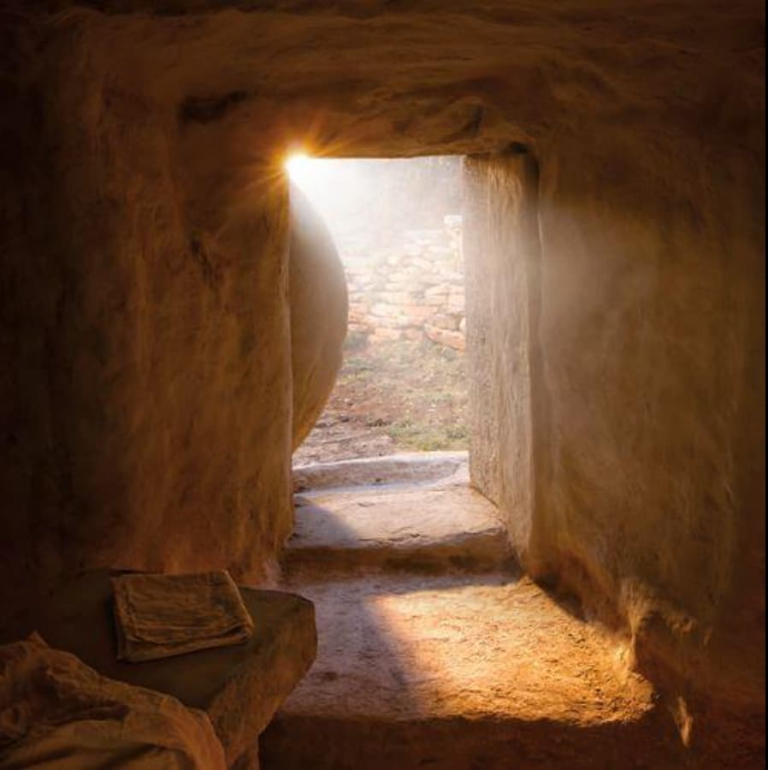
If anything, the resurrection story, read carefully, says the opposite. The disciples who encountered the risen Jesus did not simply stop grieving the way he had died. Mary wept at the empty tomb — still in the full weight of her grief when the risen Jesus stood before her, unrecognized, speaking her name. Thomas, holding his grief and his doubt together, needed to see the wounds. The resurrection did not erase what had happened. It moved through it.

Christian hope is not the claim that death does not matter because something better is coming. It is the claim that the one who died — the specific person, with their specific life and love — is known by God, and is not beyond God’s reaching.

This means you are allowed to grieve. You are supposed to grieve. The person you lost deserves to be grieved. The grief is not a sign that you lack faith. The grief is a sign that the love was real. And the Christian claim is that real love — love this costly, love this grief-making — points toward something that is more than chemistry and time.

## 9. An Invitation, Not a Conclusion

This is not a place where hope is handed to you packaged and finished.

Hope, when it is real, tends to be found rather than received — slowly, in the middle of doubt and grief rather than after it has passed. It tends to arrive less as a feeling and more as a quiet refusal: the refusal to conclude that the love was meaningless, that the person who was loved has simply ceased, that death is the last word.

What is being offered here is an invitation.

An invitation to not close the question. To stay with the claim that something happened at the resurrection of Jesus — something that changes what death means — and to ask honestly whether it holds.

You are welcome here with your grief, your fear, your anger, your doubt. You do not have to arrive with answers or even much hope. You need only to be willing to keep asking.

That is a faithful place to be. And you do not have to be in it alone.

### Explore Related Articles

Why Do Humans Fear Death? — The article that begins the journey and names the fear many readers carry before they can describe it.

Is Death the End? — A broader exploration of what different worldviews say about what happens after death.

What Does Christianity Say About Death? — The broader Christian framework of death, resurrection, and hope.

Did Jesus Rise from the Dead? — The historical claim on which Christian hope ultimately rests.

Judgment and Grace — A careful look at God’s justice and mercy for every life.

### Talk to Someone

If you would rather not carry these questions alone, we have a **free AI Research Assistant** available on this site. Many visitors come with questions like:

– Can grief and hope exist together?

– What does Christian hope actually mean when someone dies?

– How do I keep going when death feels close?

– Does the resurrection change what grief feels like?

– What if I want hope, but still feel afraid?

You are welcome to explore these questions at your own pace. No pressure. No performance. Just honest conversation.

Start a conversation →

If you would prefer to speak with a real person — a pastor or counselor — you are welcome to reach out to us directly. We are here.

Contact a pastor →

類似投稿