
Unveiling Quantum Mechanics: Understanding Death Through Physics
This article explores the core concepts of Quantum Mechanics, the groundbreaking physics that governs the behavior of nature at the atomic and subatomic level. Understanding this theory is essential for grasping the fundamental nature of existence.
1. The Birth of Quantum Mechanics and the Meaning of ‘Quantum’
The Limits of Classical Physics
In the late 1800s, physicists were confident that classical mechanics (governed by Newton’s Laws of motion) and electromagnetism (Maxwell’s Equations) had explained all observable phenomena in the universe. This overconfidence was shattered by two seemingly minor problems: the behavior of light (electromagnetic radiation) and the structure of the atom [1]. The inability of classical physics to account for these phenomena led to the revolutionary shift in the early 20th century known as Quantum Mechanics.
What Does ‘Quantum’ Mean?
The term Quantum fundamentally means “non-continuous.”
- Classical World: A ramp, where any value (1.1, 1.2, etc.) is possible between two points (continuous).
- Quantum World: A staircase, where only specific, separate steps are allowed (1, 2, 3) [2]. This is called Quantization (the idea that physical properties can only take on discrete values).
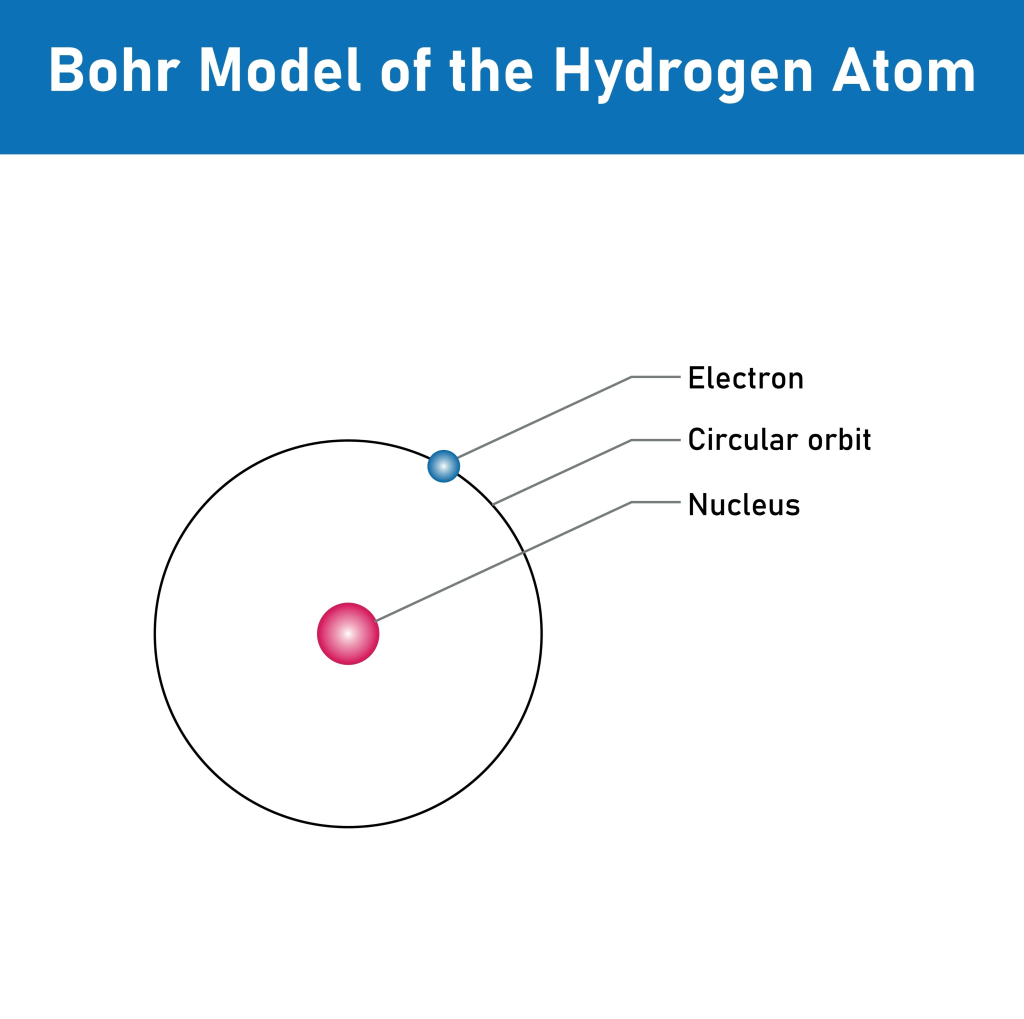
- The Electron’s Orbit: For an electron orbiting an atomic nucleus, it cannot exist in any orbit it chooses. It is restricted to specific, defined, non-continuous energy levels or shells (like orbits 1, 2, or 3) [3].
2. The Two Core Principles of Quantum Mechanics
(1) Wave-Particle Duality
In our everyday, macroscopic world, we observe distinct entities: particles (like a billiard ball, which collides and bounces) and waves (like sound or water waves, which pass through each other). Quantum Mechanics revealed that in the microscopic world of atoms, matter exhibits a duality, possessing the characteristics of both a particle and a wave.
- Wave Nature and Quantization: Electrons, which we typically think of as particles, behave as waves when orbiting the nucleus [4]. For these electron waves to be stable, they must form standing waves (where the wave’s beginning and end match up perfectly without fading). This requirement forces the electron’s wavelength—and consequently its energy and orbital size—to be restricted to specific multiples, thus explaining why the orbits are quantized (discrete) [5]
(2) The Uncertainty Principle
- Classical Mechanics’ Claim: By precisely measuring an object’s current position and momentum (speed and direction), its future can be perfectly predicted.
- Quantum Mechanics’ Rebuttal: The Heisenberg Uncertainty Principle states that it is fundamentally impossible to simultaneously know both the exact position and the exact momentum of a quantum particle (like an electron) [6]. The act of measuring one property inevitably disturbs the particle, changing the other property.
3. Superposition and Measurement: The Strangeness of the Quantum World
The Wave of Probability
In Quantum Mechanics, the wave associated with a particle is not a physical water wave, but a probability wave (often called the wavefunction).
- The amplitude (height) of this wave at any point indicates the probability of finding the particle at that specific location. Where the wave is high, the particle is more likely to be found.
Quantum Superposition
The combination of probability waves leads to the bizarre concept of Superposition.
- Concept: A quantum system (like an electron) exists in all possible states simultaneously until it is observed [7]. For instance, an electron could be in orbit 1 and orbit 2 at the same time.
- Analogy: It’s like having a person simultaneously exist in two locations behind you. The moment you turn and look (observe), the person instantly “chooses” one location and appears there.
The Collapse of the Wavefunction
The moment we interact with a quantum system—the act of measurement or observation—the superposition ends.
- Collapse: The simultaneous states instantly reduce, or collapse, into a single, definite state. This is known as Wave Function Collapse [8].
- Definition of Observation: In physics, “observation” is not just seeing with your eyes. It is any interaction where the quantum particle collides with any matter, such as an atom, a dust particle, or a photon [9].
The Double-Slit Experiment
The famous Double-Slit Experiment demonstrates the true power of this concept:
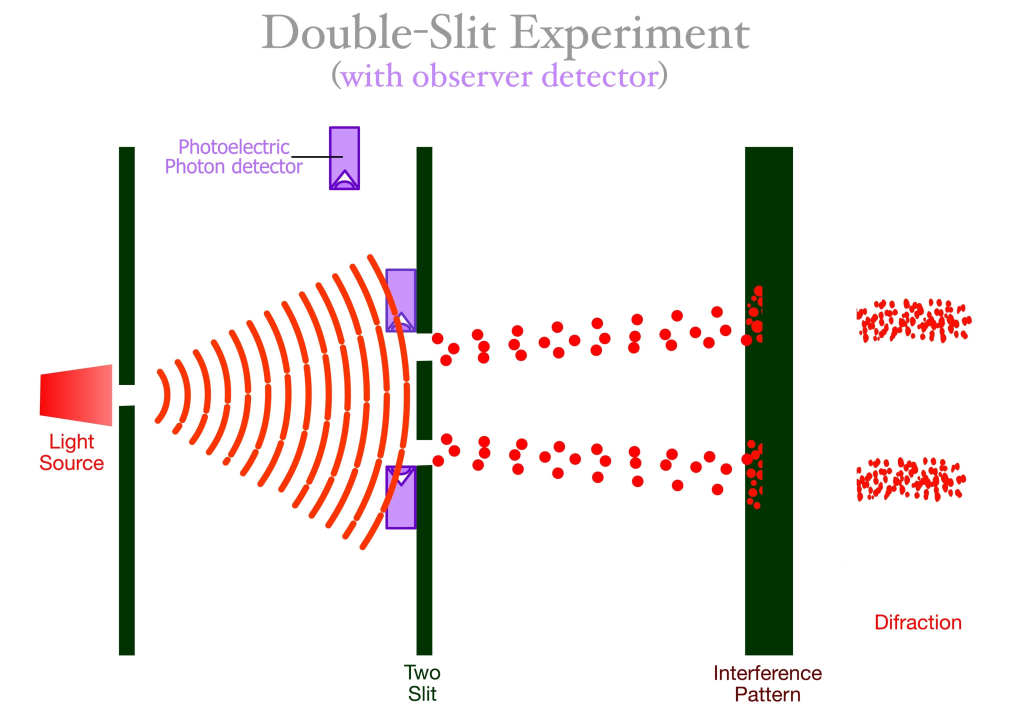
- No Observation: When tiny particles (like electrons) are fired at a screen with two narrow slits, and no one is watching, they act as waves, creating an interference pattern (like water waves merging) on the detector screen [10].
- With Observation: The moment a detector is placed at the slits to observe which slit the electron goes through, the particle immediately ceases its wave behavior and acts as a particle, eliminating the interference pattern. Observation forces the wave (probability) to “collapse” into a definite location [11].
4. Famous Puzzles and Debates
Schrödinger’s Cat
Physicist Erwin Schrödinger proposed this thought experiment to highlight how ridiculous he found the idea of superposition when applied to the macroscopic world.
- The Paradox: He linked the decay of a single, quantum-level radioactive atom (which is in a superposition of decayed/not decayed) to a mechanism that would kill a cat. According to the Copenhagen Interpretation, the cat, being linked to the quantum state, would exist in a superposition of both alive and dead until the box is opened and the system is observed.
- The Interpretation: While this scenario is practically impossible in our world, it fundamentally questions where the line between the quantum and classical worlds lies.
The EPR Paradox and Quantum Nonlocality
Albert Einstein (E), Boris Podolsky (P), and Nathan Rosen (R) proposed the EPR Paradox to challenge the completeness of Quantum Mechanics.
- Locality Principle: Einstein argued for Locality—that no influence or information can travel faster than the speed of light, meaning two distant objects cannot instantaneously affect each other [12].
- The Paradox: Using entangled particles (two particles linked so that measuring one instantly tells you the state of the other, no matter the distance—like two cards that must add up to 10), they argued that the immediate knowledge of the distant particle’s state implied that something “real” was being determined instantly, violating the speed of light limit.
- Experimental Confirmation (Nonlocality): Experiments have consistently shown that the states of entangled particles are indeed correlated instantaneously, regardless of distance. This phenomenon, which Einstein famously called “spooky action at a distance,” proves that the quantum world is nonlocal [13]. This confirmation of quantum nonlocality was recognized with the 2022 Nobel Prize in Physics.
5. Interpreting Quantum Reality
The Copenhagen Interpretation
- The Majority View: This interpretation, primarily formulated by Niels Bohr and Werner Heisenberg, is the most widely accepted. It asserts that the quantum state is merely a mathematical description of probabilities, and reality only comes into existence upon observation [14]. Prior to observation, the quantum system is not “real” in the classical sense.
The Many-Worlds Interpretation
- An Alternative View: This interpretation suggests that when a measurement is made, the wavefunction does not collapse. Instead, every possible outcome of the superposition is realized in a different, non-interacting universe [15]. When you observe the electron in orbit 1, another universe splits off where the electron is in orbit 2.
6. Quantum Mechanics in Our Daily Lives
Laser Technology
Laser (Light Amplification by Stimulated Emission of Radiation) technology is a direct application of quantum physics.
- Normal light contains waves with various phases (the wave’s “starting point”) and wavelengths. A laser, however, is created when photons (light particles) are emitted such that their waves are perfectly in phase and have the same wavelength [16]. This coherence allows the beam to remain narrow and powerful, making it essential for everything from barcode scanners to precise distance measurements (like measuring the distance to the Moon).
Why We Don’t See Quantum Effects
We don’t observe everyday objects (the macroscopic world) tunneling through walls or existing in multiple states because of decoherence.
- When many atoms form a large object, the slight thermal vibrations and external interactions cause their individual probability waves to become completely out of phase (misaligned) [17]. This prevents the wave-like properties from exhibiting themselves, forcing the object to act purely like a classical particle.
Key Search Keywords
- Quantum Mechanics
- Superposition
- Wave-Particle Duality
- Heisenberg Uncertainty Principle
- Wavefunction Collapse
- Schrödinger’s Cat
- Quantum Entanglement
References
| No. | Content | Academic Basis |
| 1. | The limits of classical physics (light and atom) | Planck’s solution to the Black-Body Radiation problem and Bohr’s model for the hydrogen atom. |
| 2. | The non-continuous meaning of Quantum | Max Planck’s constant $$h$$ and the concept of discrete energy packets (quanta). |
| 3. | The quantized orbits of the electron | Niels Bohr’s atomic model (Bohr-Sommerfeld quantization). |
| 4. | The wave nature of matter (duality) | Louis de Broglie’s hypothesis on matter waves ($$\lambda = h/p$$). |
| 5. | Orbital quantization due to standing waves | The requirement for de Broglie waves to form a standing wave around the nucleus circumference. |
| 6. | The Uncertainty Principle | Werner Heisenberg’s formulation of the Uncertainty Principle ($$\Delta x \Delta p \geq \hbar/2$$). |
| 7. | Quantum Superposition | The principle of superposition in quantum states (linear combination of possible states). |
| 8. | Wave function collapse upon observation | The postulate of wavefunction collapse upon measurement (Born rule). |
| 9. | The physical definition of observation | The concept of decoherence, where interaction with the environment (e.g., collisions) effectively constitutes a measurement. |
| 10. | Double-slit experiment (before observation) | The observation of interference patterns characteristic of wave behavior. |
| 11. | Double-slit experiment (after observation) | The disappearance of the interference pattern due to the collapse of the wavefunction. |
| 12. | The Principle of Locality | Albert Einstein’s Theory of Special Relativity, stating that no signal can travel faster than the speed of light. |
| 13. | Quantum Nonlocality (Entanglement) | Bell’s Theorem and the experimental tests (e.g., by Aspect) confirming that quantum entanglement violates local realism. |
| 14. | The Copenhagen Interpretation | The philosophical stance that the wavefunction is only a calculation tool, not a description of objective reality before measurement. |
| 15. | The Many-Worlds Interpretation | Hugh Everett III’s Relative State Formulation (Many-Worlds Interpretation). |
| 16. | Laser Principle | Albert Einstein’s theory of stimulated emission, which is the core mechanism of laser operation. |
| 17. | Reduced quantum effects in the macroscopic world | The rapid process of decoherence caused by environmental interaction, which makes superposition unobservable in large systems. |