
Consciousness After Clinical Death: Empirical Evidence Analysis Through Revival Cases
1. 🌟 Introduction: Redefining the Boundary of Death and the Need for Research
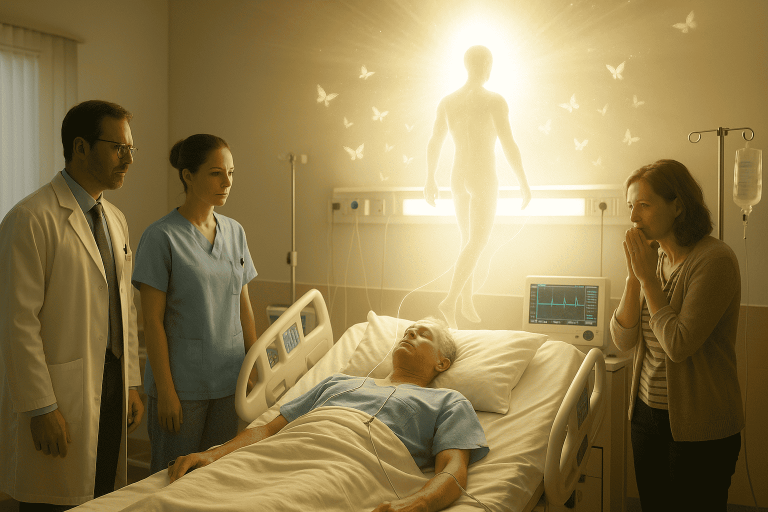
For ages, humanity has wondered about the state that follows death. With the advancement of modern medicine, the success rate of cardiopulmonary resuscitation {CPR} has increased, leading to the reality of a miracle where countless individuals, once medically declared deceased, return to life. The experiences of these survivors are documented as the phenomenon known as a Near-Death Experience {NDE}, which includes astonishing consistency and objectively verifiable details, making it difficult to dismiss as merely a chemical reaction in the brain.
This report seeks to answer the fundamental question: “Is the end of consciousness synonymous with the end of the physical body?” To do so, we analyze data from medically confirmed {NDE} cases and the Lazarus Phenomenon to present a logical and rational basis for the potential persistence of consciousness at the point of clinical death.
2. 🔍 Fact-Based Analysis of Clinical Death and Revival Phenomena
2.1. Medically Defined Revival Phenomenon: Lazarus Syndrome
Lazarus Syndrome is a very rare but medically reported phenomenon characterized by a delayed Return of Spontaneous Circulation {ROSC}, occurring between {10} and {15} minutes after the cessation of {CPR}. Since the first case was documented in the literature in {1982}, fewer than 100 cases have been reported in academic journals to date.
Logical Basis: This phenomenon signifies that vital signs spontaneously returned after the patient was clearly pronounced dead. A significant number of the reported cases survived with favorable neurological outcomes. This provides scientific evidence that a declaration of death may not signify the absolute end of consciousness.
2.2. Statistical Scale and Objectivity of NDE
The Near-Death Experience {NDE} is a phenomenon reported by 12% to 18%{Cardiac Arrest} survivors. It is particularly significant that these experiences occur during a state of clinical death where brain activity is not measurable.
Rational Basis:
- Consistency: The core elements of {NDE} (out-of-body experience, encountering a bright light, life review, etc.) are reported similarly worldwide, regardless of cultural or religious background.
- Verifiability: In over {110}{NDE} cases, patients’ claims of what they witnessed during the Out-of-Body Experience {OBE} were objectively confirmed through later medical records or the testimony of independent witnesses.
- Doctor’s Testimony: Even individuals with a scientific background, such as neurosurgeon Eben Alexander, MD, testified that the {NDE} he experienced during a severe brain injury {Coma} was a “transcendent reality,” proposing the hypothesis that consciousness may not be subordinate to brain activity.
3. 💬 Testimonies of the Revived: A Message about Life and Death
The core of the testimonies from the revived is overwhelming peace and love—an experience completely opposite to the pain or fear expected at the moment of death.
- Message at the Point of Revival:
- Most survivors report, “It was so beautiful I didn’t want to come back,” and describe the experience as “more real than life on Earth.”
- Testimonies like that of Tessa Romero describe being enveloped in unconditional love in a state where physical and emotional pain had completely vanished during {24} minutes of cardiac arrest.
- Life Review and Moral Evaluation:
- At the heart of the {NDE} is the “Life Review,” a process where all of one’s actions are re-evaluated through the pure lens of empathy for their effect on others. Survivors universally attest that this experience led them to deeply realize the importance of a moral life.
4. 📈 Conclusion: Permanent Life Change and the Significance of the Report
The experiences of those revived after being medically declared deceased permanently change their subsequent lives. This transformation is the most powerful empirical evidence supporting that the {NDE} is not a simple hallucination or dream.
- Core Changes:
- Loss of the Fear of Death: The fear of death disappears as they perceive death not as an end but as the next stage.
- Value System Transformation: They shift focus to spiritual values like love, relationships, and service rather than material values like money and power.
This consistency, objectivity, and the permanent depth of these changes strongly support, at a logical and rational level, the hypothesis that a realm of Consciousness exists beyond the boundary of clinical death, one that transcends brain activity.